The bachelor’s in Journalism and Mass Communication is a four year comprehensive degree designed according to New Educational Policy (NEP) to bring out new age media professionals with the highest emotional quotient. The ever-expanding verticals of the creative and service industry are offering a sea of opportunities to students in the news industry, political communication, public engagement, communication research and digital content industry.
LL.B. is a three years undergraduate degree programme in Law enabling the students to get requisite knowledge of basic laws, both substantive and procedural laws, to be skilled legal professionals.
B.B.A.LL.B. is a Five years integrated undergraduate degree programme in Law enabling the students to get requisite knowledge of business administration and fundamental laws
The B.A. in Psychology Course ensures that the students are acquainted with the field of Psychology, branches in Psychology, various schools of thought, recent trends, theoretical as well as applied areas, and research methods in the field.

‘Touch the Sky With Glory’ – true to their motto, the Indian Air Force is an embodiment to the grit, determination, and grace. On this Air Force Day the nation salutes the spirit of sacrifice, courage and the inspiring discipline exhibited by our men in blue! Be it emergency evacuations, search and rescue operations or a full fledged war, the Indian Air Force always leads from the front! On 8th October 1932, the Indian Air Force was officially established by the British. That is why 8th October every year is commemorated as the ‘Air Force Day’. The day is celebrated with the public display of synchronized adventurous air shows at Hindon, near Delhi.
The Indian Air Force boasts of a glorious history of achievements starting from the Second World War when it halted the Japanese army in Burma and other South Asian countries. It played a decisive role in “Operation Vijay” for Goa’s annexation to India, the victory of Bangladesh Liberation War in 1971 and the Kargil War in 1999. Fact Check - Did you know that the President of India is the supreme Commander of the Indian Air Force?

A long engulfing silence hung between them, shattered intermittently with silent sobs at both ends of the phone line. 25 years have passed since that fateful day, people have picked up the broken threads of their lives and moved on, but memories are stubborn. Incase you are wondering what I am talking about, well the story begins 25 years ago when Latur was struck with a massive earthquake.
As residents of Latur went to bed that night, little did they know that for many it would prove to be their final night. Still hungover after the relentless festivities of the recently concluded Ganesh Utsav, Latur was ravaged by a devastating earthquake, in the wee hours of 30th September,1993, measuring 6.4 on the Richter Scale. This was a calamity of unprecedented proportions that claimed 9,748 lives and left 30,ooo injured. Overnight the city known for its enchanting Kharosa Caves was reduced to a haunting heap of debris and dead bodies.

Broken Homes. Broken Dreams.
Nature’s fury knew no end. The rescue and rehabilitation work was severely hit by torrential rains that followed the mighty earthquake. Lt. Col. Sumeet Baxi, then freshly commissioned into the Indian Army, was deputed on the rescue mission to retrieve the trapped under the debris. As bodies were dug out, he worked day and night giving them a respectable burial and taking the injured to the hospital. Days passed by and the odds of finding anyone alive under the debris was getting smaller than the point of a fine needle. But as they say in Hindi - ja ko rake sayian mar sake na koi (The one protected by God can’t be killed).
On 5th October, 1993, four days after the catastrophic earthquake struck Latur, Lt. Col. Baxi heard feeble cries of what seemed like the voice of a baby from under the debris. Springing into action, Lt. Col. Baxi slipped through the precarious gaps that could have been fatal to his own life and pulled out a baby girl with her pulse still beating. The 18 month old girl was spontaneously rechristened Priya by the brave heart officer who handed her over to her overwhelmed father. 25 years went by and Lt. Col. Baxi’s army posting brought him to Pune. He came to know about the whereabouts of Priya, now in her 20’s, a confident young school teacher. Hesitant yet curious Lt. Col. Baxi picked up the phone to ask about her well being. Overcome by emotions, he found himself struggling to strike a normal conversation with Priya. A long engulfing silence hung between them, shattered intermittently with sobs at both ends of the phone line. “Thank You” - is all Priya managed to utter.
Unlike what we are accustomed to - taut muscles, handsome, shiny hair and being gallant at the drop of a hat, heroes come in all shapes and sizes. Reality is more complex and interesting than fiction. Lt. Col. Sumeet Baxi might seem like an ordinary man going about his daily business yet there lies around him the ring of a halo of heroism. For one who saves a human being, it were as if, one has saved entire humanity. By saving a life, a future, an aspiration that will create a difference by just existing, when it almost wasn't meant to be.

Debris of Hope
On 1st October, 2018 Lt. Col. Sumeet Baxi was felicitated by Vishwakarma University, Pune for his heroic act and selfless service during the Latur earthquake.
The audience were enthralled and deeply moved when Dr. Siddharth Jabade, Vice Chancellor, Vishwakarma University narrated the tale of valour of Lt. Col. Baxi to the audience present.
Prof. Mitali Kulkarni, Art and Design department, presented Lt.Col. Summit Baxi with a beautiful painting depicting his heroic act and Priya's journey of becoming a teacher today. Dr. Siddharth Jabade announced the noble initiative of VISHWAS, an NGO under the aegis of Vishwakarma University, to adopt the village called Mangrul in Maharashtra.

A CASE FOR LIBERAL ARTS
Keeping up with globalization has lead to an enquiry of knowledge domains, previously unexplored. The explosion of knowledge has meant that while specializations are in demand, yet subject parochialism can no longer pass off as acceptable. The previous yardstick of measuring knowledge value in ways no longer hold true. It demands a renewed conversation on the practice of knowledge production at this particular contemporary moment, and a broader conversation on the activities and institutions that shape an understanding of the utility and nature of such knowledge.
Binaries of class, caste etc have crept into education as well. As with all binaries, one entity invariably takes on a superior position. There are two distinct camps in higher education - Science, Technology, Engineering and Maths (STEM) vs Humanities. While STEM is seen to be practical, real, with high employment potential, liberal arts is viewed to be elitist, self- indulgent and vague. This misunderstanding largely emerges from understanding liberal arts to be synonymous with humanities. To make clear the confusion: Liberal arts is a fusion of pure sciences AND humanities. It defies the straight jacketed distinction of arts and science.
WHY INTERDISCIPLINARY EDUCATION IS IMPORTANT ?
A liberal arts education is not about learning any one kind of content or text book. It’s about learning how to synthesize novel ideas, develop critical thinking, develop an aptitude to research, ability to adapt to new situations, meaningful enquiries, to be tolerant of differences, develop problem solving abilities, effective communication, clarity of concepts and thinking etc. We have falsely come to believe that education is only about collecting degrees and finding employment. Yes! it is that too but if one hopes to attain success in a professional career one needs more than that.
The world is a complex place and there are no linear solutions to its problems. Problems like climate change, hunger, terrorism etc. cannot be resolved using parochial straight-jacketed solutions. They need a multidimensional approach.
The dominant thought is that only a degree in engineering or management can secure you a job. It is far from the truth. Media, fashion, education, publishing, commerce are some of the industries that do not involve STEM and yet provide livelihood. Even the IT industry requires all sorts of non technical employees to run the company. In the evolving global employment landscape, employees that can work in multi-professional teams and adopt holistic approaches to problem-solving are preferred over the ones who bring limited skills to the table. Only a scientific or technological education devoid of any social context makes a tool out of an employee not a thinker. Employers are looking for people who can find innovative solutions to problems and can approach the issue at hand from different angles.
Indira Nooyi, CEO, PepsiCo, an inspiration to many, in an interview said that apart from hard work one needs to be well informed and have extraordinary communication skills to climb the ladder in any high-tech industry. An interdisciplinary education is a must to make us a wholesome individuals and inculcate these skills in the young graduates.
WHY WE NEED LIBERAL ARTS MORE THAN EVER BEFORE?
I believe that in the contemporary times of great division and bigotry, a liberal arts education is more important than ever. It forces us to admit and understand that a uniform world view is dangerous and boring. That world is fluid, there are no concrete truths and no one ‘right’ answer.
A liberal arts education ignites the passion for rational debate, the ability to ask uncomfortable questions, question the status quo and introduce students to an ever expanding world of ideas. It leans toward openness instead of containment. It forces us to continually revisit our view point, understand our own position in the world and broaden our ideological borders. Most importantly it makes us realize that it’s ok to not subscribe to the uniform notions in any walk of life. That people and cultures other than ours are as human and as real as our own.
In my view liberal arts education enables one to embark the path of innovation and creativity in whichever career one chooses to pursue. It is those who can think nimbly and responsibly who end up building bright careers.
The author of this article, Richa Singh is a content writer with Investronaut. She is a voracious reader and a keen traveller.
Rohit Karnatak and Prakash Patil are the in-house graphic designers with Investronaut. While seated in a snug corner of our office, I tried to make sense of their journey through the lights and shades of their profession. What is the nature and scope of this profession? Read to find out.

1. Explain to the lay reader out there who is a 'graphic designer' ? How does one become one and what qualities/traits must an aspiring graphic designer have?
Response - Simply put, bringing inanimate text to life visually! There is no one job that a ‘graphic designer’ does, rather a designer offers a bouquet of services to make the product visually appealing.
A graphic designer assembles images, illustrations, typography, vector elements (shapes) and colors to bring a design to life. Graphic designers play a vital role in the animation and the publishing industry. They design sets, backgrounds and logos. Graphic designers also work as user interface designers, brand identity designer, web and app designers. The options are numerous.
Being a creative profession, an eye for color, understanding of shapes and a creative bent of mind is a necessity. A degree in graphic design can teach you the basics but like any other field most of the learning takes places 'on the job’. To succeed as a designer, you need to keep your eyes open, be observant and one must learn to think on your feet.
2. Please walk us through your journey to become a designer.
Rohit - I am self taught. I was working as a Computer Engineer when by a slice of good luck, I was assigned a project to develop a website. I was expected to learn and use Photoshop for it. That’s when I discovered the joy of creating something new! I instantly knew that this is what I wanted to pursue further.
Initially, I relied on video tutorials to learn the basics. It was tough as I had no prior training in the field. My team in Flexton Inc., the company I was working for at the time, understood quickly my inclination towards graphic designing. So, I was deliberately assigned design-related projects which turned out to be a blessing indeed! It’s been four years since I have been working as a graphic designer now, and I have not looked back ever since.
Prakash - I was never good at studies but I excelled in drawing and painting. My teachers in school spotted that and encouraged me to take up Elementary and Intermediate art exams. That gave me confidence and I decided to study arts after school. My two years in art school and later a course in graphic designing gave me a solid grounding and understanding of the field.
A degree in graphic designing is not mandatory but it teaches you how to brainstorm ideas, inculcate a sense of colors and teaches you the importance of observation.
In the last 8 years my journey as a graphic designer has given me immense creative gratification and diverse range of assignments have fine tuned my craft.
3. Drawing from personal experiences, as well as those you have known, how does a graphic designer contribute to the development, marketing and distribution of a product?
A sample of Rohit Karnatak’s work showcasing his angst against capitalism, hollow notions of being cool and his idea of boundless imagination.

Rohit & Prakash - A graphic designer’s contribution is immense! See human beings are mostly and primarily visual. We see first and then decide in most cases. This is where the designer comes in. Graphic Designers transform a product into a brand. Graphic designers channel their creativity to design campaigns that intrigue, and delight the customers and so customers stay with them longer! A longer stay naturally means greater revenues. Therefore the designer amplifies the message visually which in turn which motivates the customer to try the product. An article on the Web or curiosity towards a book is greatly influenced by the cover image. As they say the first impression is the last impression, and so we often judge a book by it’s cover. Be it a hoarding, a logo or an advertisement, it is the designer’s job to get it right. Their work will go a long way towards determining the reach and popularity of a product.
4. From your own experience and of others, what are the possible challenges a graphic designer faces in course of work? How must they be overcome?
Rohit & Prakash - The biggest challenge is to not be repetitive. If we are promoting three brands of soap, each one has to have a distinct identity. So, one has to have a fresh perspective each time, with new ideas that can be translated into new designs, videos and images.
Some brands like Mercedes and Wills have established their brand identity with minimalistic designs - a simple logo against a dark background. They apparently look very simple, but it is actually the result of a careful thought by the designer. But once the logo is established, the designer’s job increases manifold, as the template is set. Now the designer has to walk a tightrope between keeping the brand identity intact yet vary it so as to keep the campaign fresh, else stagnant waters stink, and familiarity breeds contempt.
Another challenge is to keep pace with the new softwares that come to the market every so often. One has to learn them if you don't want to turn obsolete.
On a personal level there are days when you are not feeling particularly inspired and creative. Yet, on some days the work is urgent, and there is no scope to procrastinate. Then, the challenge is to overcome that and find ways to keep the creative juices flowing. The trick to keeping monotony at bay is to expand your canvas. As with every art, so with design. The designer’s first audience must be one’s own self - create primarily for yourself and savor the joy of creating, without having a client or product in mind.
A sample of Prakash’s work for leading Investronaut clients.

5. Innovation is the favourite word of the corporate world these days. Do graphic designers need to innovate? Do you for example recall any time you innovated?
Response - Of course! Variety is the spice of life. Graphic Designers are no different. Innovation is the key to evolve and sustain in a competitive world. You have to change your design and approach with the changing pulse and taste of the audience. You have to constantly figure out what will click with the masses. In our current job too we innovate and try to inculcate an element of humour, video content, mailers etc. We have to constantly think of new tricks to engage new audiences in our work and keep the regular ones hooked.
6. And finally what are the career opportunities and advancement options that are available to a graphic designer?
Rohit & Prakash - There is an evolving hierarchy and career path one can follow as a Graphic Designer. After honing your skills for a year or two as an intern or a Junior Graphic Designer, one can become a Graphic Designer. After 5-10 years of experience one can join as a Senior Graphic Designer. Another 5 years in your kitty and you become a Visual Graphic Designer. All this culminates with one becoming a Creative Head after 18-20 years of experience.
Life as a Graphic Designer is like a gust of fresh air everyday. It forces you to challenge the limits of what you already know. It is financially rewarding and creatively gratifying as a career. If you are fresh out of school, a graduate or someone stuck in a stifling profession and looking to unleash your creativity and make a decent living out of it too! This could be your best bet!
The author of this article, Richa Singh is a content writer with Investronaut. She is a voracious reader and a keen traveller.

Media Laws and Freedom of Speech
Tweet. Post. Express - whether it be in print or digitally and no one can harm you. But this wasn't so before 2015. In 2015, in a landmark judgement the Supreme Court struck down the controversial section 66A of the Information and Technology Act, 2000 which allowed the state to arrest people for posting offensive content. The incident that led up to this judgement was when in 2012, two young girls were arrested when one of them wrote a Facebook post criticizing the bandh following the death of Shiv Sena leader Bal Thackeray, while the other one ‘liked’ it. The incident raised critical questions about the freedom of expression in the country. What resulted was that ‘legally’ one could express themselves without fear of retribution.
There is a whole framework of Media laws in India that affect our lives directly or indirectly. These laws are closely tied up with our fundamental right of freedom of speech, enshrined in the Constitution of India under Article 19(1). Media laws in India encompass all the legal issues related to censorship, copyright, Information Technology(IT) , defamation, broadcasting, privacy, telecommunication, entertainment, advertising and confidentiality in any form of media like TV, film, music, publishing and internet.
Media, often called as the fourth pillar of democracy is an important institution in a democratic set up where conflicting ideas can be debated. A critical press is the watchdog of a thriving democracy. It needs to be protected at all times. In 1950, ‘we the people’ of India gave ourselves the security of a Constitution which protects our fundamental right of speech amongst other rights. But free speech isn't absolute in India. Article 19 (2) that follows prohibits us from circulating content that is not in the interests of the sovereignty and integrity of India, the security of the State, friendly relations with foreign States, public order, decency or morality or in relation to contempt of court, defamation or incitement to violence.
Blurred Boundaries
What constitutes freedom and where do we draw the line? Where does freedom of speech end and laws begin? Laws and freedom of speech often find themselves locking horns, forming an interesting trajectory of events. Most laws are subject to interpretation by the court. What is freedom to one could be offensive to the other. That is why over the years content in the form of books, films, plays, advertisements, speeches etc. has ruffled many feathers leading up to court cases. Courts and establishments have upheld or diluted free speech over the years. Let’s run through some of the defining moments in Indian history where media curbs became the talking point for the freedom of speech.
1977 - Emergency in India from 1975 to 1977 saw censorship in the press. Many noted journalists and opposition leaders had to languish in jails. Films and stage plays felt their share of the heat. The film ‘Kissa Kursi ka’, a satirical take on the emergency, directed by Amrit Nahata was banned and its copies confiscated by the then establishment. Gulzar’s film ‘Andhi’ also met the same fate. The movie said to be based on the relationship between the then Prime Minister Indira Gandhi and her estranged husband, was denied a full release. The film was banned in 1975 after a few months after its release.
1989 - Salman Rushdie’s book- ‘The Satanic Verses’ was banned in India for allegedly hurting the sentiments of Muslims. The book lead to a fatwa against Rushdie by the then Iranian leader Ayatollah Khomeini leading to Salman Rushdie hiding underground for as long as a decade. The ban lead to a widespread debate about the freedom of expression across the world. The amusing part remains that no one in the government bothered to read the book before issuing the diktat.
2015 - Online content though still outside the purview of the censor board in India comes under attack from time to time. ‘AIB Roast’, a comedy show was taken down from Youtube by the company, after charges of obscenity mounted.
2015 - What makes us uncomfortable should be banned! seem to be the criterion of banning content in our country. ‘India’s Daughter’, a documentary made by a British film maker Leslee Udwin after the infamous Nirbhaya rape in Delhi was banned by the government fearing that it might portray India in a bad light.
2017 - The independent online news portal ‘The Wire’ broke the story about the 16,000 times spike in the revenue of BJP President’s son Jay Shaha’s company. The story got considerable traction and was widely read. Shortly after, journalist Rohini Singh and The Wire were slapped with a defamation case. The Wire rejected Supreme Court’s appeal to settle the matter outside the court citing that the article was based on facts and aimed at informing the public. The court later said “There can not be gagging of press” and The Wire does not owe an apology to anyone.
2018 - The Aadhar debate has reached the highest court in the country. The government intends to make it mandatory for something as simple as buying a sim card. It has raised issues of individual privacy and it’s potential misuse. A team of young lawyers are fighting it in the Supreme Court to spread the word that the right to privacy is “non-negotiable”. Their fight will decisively architect Indian lives in the age of unique IDs, technology and machines.
More often than not freedom has to be fought for and fiercely guarded. Freedom of speech is an ongoing debate. It is manifested in every individual decision and the decisions taken by the State for us. Any which way it is a cause worth fighting for. Taken for granted and it slips away in a wink! That is why the envelop has to be pushed everyday. Young law graduates have a lot to contribute to this field. A lot of universities are offering a specialization in Media Laws. Vishwakarma University, Pune has a robust L.L.B and L.L.M. programme. If you passionately feel about the issue, allow yourself a chance master these laws and contribute to a free, unmuzzled and healthy society.
The author of this article, Richa Singh is a content writer with Investronaut. She is a voracious reader and a keen traveller.

Companies look for that X-factor that will distinguish them from their competitors and yield higher prominence to them in the market. For that, it is important that workplace potential is harnessed optimally and employees are given a conducive environment to develop their creative potential. If ever a proof of the same was required, then Google’s 20 percent program should settle it. Google allows its developers to spend 20% of a working day on side projects. The aim is to elicit, nurture and advance creativity and innovation by allowing space and time for innovation to employees. And if ever a doubt was cast on its efficacy then the origin of some of Google’s best products like Gmail, Google Talk from this scheme should quash it.
Creativity may be inborn but it needs the right environment and stimuli to flourish. As an employer it is your prerogative to ensure that such a climate exists at your workplace. But the million dollar question is: how do we produce such an environment? Let us look at a few techniques which can foster creativity in the workplace:

A key element in ensuring creativity is to be empathic to the process of creativity. Ensure that boredom finds no place in your work structure. Junior employees often complain, and not without reason, that they get to do repetitive, and mundane work and as the axiom goes - familiarity breeds contempt. An employee will not be motivated by an easy task which she/he is too well versed with. Their interest will be piqued when there is an element of challenge – unfamiliarity in the task. When an employee feels that there is an opportunity to learn something that he/she does not know, their interest and creative prowess will be amplified automatically.
Often a challenge brings forth the best in a person. Employees prefer a task that sets a premium upon its solution and challenges their creative potential. Take the example of the ubiquitous Walkman of the late 70’s. One day, Sony co-founder Akio Morita challenged his chief engineers to create a hi-fi no bigger than a small wooden block. The challenge fired the imagination of his engineers and led to the release of the Walkman in 1979. Creative people like challenges — the more challenging the task, the better.

You must ensure that creativity is placed at par with the other facets of the job, if not higher. Creative ideas which lead to an increase in efficiency should be rewarded proportionally. This will create the necessary motivation for it. However, we may ask: how should we decide on the reward? Money, bonus, awards……? I am afraid, No! they can be useful but creativity and innovation cannot be ensured by these factors only. For starters honest praise and appreciation is a good way to keep the employee motivated. Employees often treasure praise from people they respect — such as their peers, boss or mentor. Remember: “While a difficult task may be worth his while, a thankless task is not.”

Without implementation, no reward or incentive can motivate the employee to engage in creative thinking. The creative suggestions put forth by the employees must be turned into action. It is not enough to simply gather creative ideas. If an employee discerns that their creative ideas are not implemented, their motivation is likely to be reduced. A reward will not offer an employee the same satisfaction as its implementation.

Often the employees may be hesitant to divulge their ideas for fear of making mistakes. The employees need to be reassured that mistakes are a part of creative phenomenon. Creativity, in fact, works often by hit and trial method till one settles into a creative pattern. Employer support is one of the key elements of a creative workplace. If the employer is unresponsive and unsupportive, the employees will be scared away from experimenting in all likelihood.

Instead of providing assignments with restricted guidelines and instructions, apprise the employee of the ultimate goal of the assignment. Allow them to get the work done, as and how they please, with minimal interference on your part. Trust the employee’s capacity to deliver. This makes the employees feel motivated and recognize that they have authority and power over their fields.

Exchange of ideas is difficult in a situation where everybody thinks alike. Employees should be therefore hired from diverse backgrounds, qualifications and skills. Homogeneity can lead, undoubtedly, to greater team bonding and a stronger inter-personal relationship. However, this will prove to be the bane of creativity at the drawing board. A uniform and agreeable crowd can prove to be a serious impediment for creative ideas to flourish. You could consider relaxing the norms for recruiting your staff and allow for a more diverse criterion in your selection. This will permit diversity in the workplace. Hiring staff from different domains and background and allowing them to mingle around, in projects is a handy tool for ensuring creativity in the workplace. Organize more informal interactions between employees with dissimilar profiles to facilitate exchange of thoughts.

it’s important be fair to your employees, treat them with respect and make sure your employees never get a perception of being wronged for it leads to a total erosion of motivation and creativity.
The author of this article, Richa Singh is a content writer with Investronaut. She is a voracious reader and a keen traveller.
The most effective means to remain in touch with our real self and to maintain a sense of identity is to indulge in reflection and introspection. The consequences of not taking time out to pause and reflect are psychologically wide-ranging.

"If we were not so single-minded
about keeping our lives moving,
and for once could perhaps a huge silence
might interrupt this sadness
of never understanding ourselves
and of threatening ourselves with death."
Poet Pablo Naruda’s lines from the poem ‘Keeping Quiet’ aptly describe our existence in the hyper-real world where we all seem to be continually pushing the Sysiphian wheel. We dare not waste a minute! In our relentless race to perform and produce, reflection and introspection have become lost arts. We are consumed by a temptation to just finish this or do that. The perils of perpetually denying ourselves uninterrupted time to reflect may result in losing connection not just with others, but also with ourselves. Denying the mind to wander off freely in different directions is counter productive to creativity, deep insights, productivity and personal growth.
Doing nothing and the culture of shame.
Try telling your parents that you want to take a year off to reflect on your life. You are likely to get an earful on losing out in the race! In most cultures, doing nothing is associated with shame, guilt and wasting time.
We also associate doing nothing with boredom. So, when we have free time, we try to fill it up with distraction-inducing activities like constantly checking our phone or watching TV which stimulates our brain, giving us the impression of being happy which makes it irresistible to stop. We get sucked in the vicious circle of social media - looking at pictures, liking and commenting on posts. It might give us an impression of being productive but the fact is that social media is a reactive medium, it lacks originality and its prolonged use burn us out psychologically.
Corporate Workplaces
Recently a video went viral on social media where an employee is shown being taunted by a colleague as he is leaving office after a grueling 9 hours of work. The employee gives a long befitting reply to him as to how he has a life outside the office too! As much as the video tickles us it is relatable and rooted in reality. Unfortunately the culture of putting in long hours at work is encouraged by contemporary organizations as it is useful for them. Employees who put in long time in office are rewarded, encouraged and supported for it suits their purpose. Instead of discouraging workaholism, organizations go by the attitude that “I am paying that person a salary, why aren't they at their desk when I am still in office?” A perception is framed that people working longer, work harder. But there is no relationship between working hard and working smart. Workaholic work environments are unhealthy, they may lead to serious mental and health problems, relationship breakdowns, low motivation etc. Companies fail to realize that the best employees are those who both act and reflect. Reflection requires unplugging from the compulsion to keep busy.
Compulsory Downtime
Somewhere down the line it is becoming acceptable to live at an unhealthy pace. But remember Newton discovered the laws of gravity while contemplating under a tree! Likewise Archimedes had his eureka moment in the leisure of his bath tub! Slower rhythm of life give our mind the necessary downtime.
Downtime, which includes reflection and introspection enables not only our creativity and our need for rest, it also enables the formation and maintenance of our deep sense of being and identity. Identity is discussed in terms of the Self by the great Swiss psychiatrist Carl Jung. For Jung, integration of all our life experiences into a whole forms the Self. This Self needs to be nourished with contemplation and introspection to maintain a sense of identity.
We need a certain balance and equilibrium within ourself and with our environment. Yet in the forever connected and time-driven world we inhabit, we are far from equilibrium. The time and space for personal reflection is often consumed by long work hours, social commitments and smartphone addiction, resulting in a lack of mental peace and quiet necessary for inner stability. Without the mind having free downtime our emotional, spiritual and psychological health will suffer. It is during ‘wasting time’ or downtime that our inner most self speaks to us. The events of the past that have held personal meaning for us whisper to us in those quiet moments.
So take long walks, longer naps and indulge in day dreaming to be the best and most efficient version of you.
The author of this article, Richa Singh is a content writer with Investronaut. She is a voracious reader and a keen traveller.

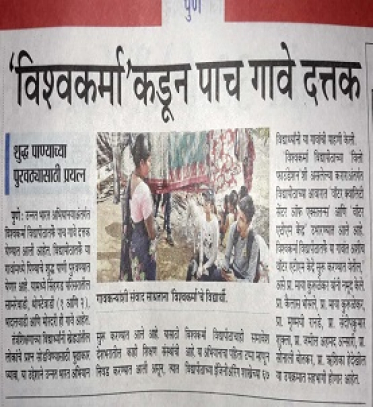
Pune : Education doesn’t mean limiting a student to curriculum. It goes beyond that and in fact cocurricular and extracurricular activities play an important role in shaping a student as not mere a degree holder but a responsible citizen too. Social bonding at young age helps develop an understanding of society and people living around us. With a view to inculcate this understanding Vishwakarma University (VU) has participated in MHRD’s Unnat Bharat Abhiyan. Recently, VU has adopted 5 villages around Pune city under this project. In coming days, students and faculty together will make sure that villagers in these villages drink pure water, which is a severe issue at present.

What is Unnat Bharat Abhiyan?
Unnat Bharat Abhiyan is inspired by the vision of transformational change in rural development processes by leveraging knowledge institutions to help build the architecture of an Inclusive India. Technical institutes from across the country have been selected for the project and VU is one of them. The idea is to adopt villages, understand their persistent issues and find solutions with the help of technical know-how of students as well as faculty members.

How VU is approaching the project?
‘The aim is to sensitise students about issues of society. Many a times while living in a metro city, we are unaware of problems of people staying in villages on the border of the cities. Students should understand the real-world problems and find answers to them using available resources there. We are approaching the Unnat Bharat Abhiyan with this view,’ says Prof Maya Kurulekar of Faculty of Science and Technology who is guiding the students.

What did VU do as a part of the project?
VU has adopted Samrevadi, Bhadalvadi, Thopatevadi (1 and 2) and Mordari villages near Sinhgad Fort. All these villages have less than 400 households. They lack many primary facilities including pure drinking water. As the project started, first thing that was done was a survey of these households. Nodal officer Prof Kailas Bhosale has been coordinating the project for VU. He motivated as many as 67 students from the first year BTech course to do a comprehensive survey in these five villages. According to Prof Bhosale, the survey was carried out to identify the basic issues. The findings of the survey will be uploaded on the portal of Unnat Bharat Abhiyan. While doing this survey, students found that villagers were using water from wells but the quality was poor. As a result, villagers face medical issues. Students also found that medical facilities were far away from homes and villagers needed to travel quite a distance to access them. ‘After the survey was done, we decided to focus on one issue at a time. To begin we have focussed on providing pure water. We have a tie up with Wilo Foundation for Water Quality Centre of Excellence. Wilo India Limited has developed and sponsored Water ATMs for this centre where this water is processed and pure water is provided. We have one such Water ATM at VU campus. We plan to establish similar Water ATMs in these villages from where villagers can drink pure water. We also had discussion with Gram Panchayats for providing water to these Water ATMs per day for purification,’ mentions Prof Bhosale.


Participants
Along with 67 first year BTech students Prof Mrunmaee Randade, Prof Sandeep kumar Shukla, Prof Jameel Ahmad Ansari, Prof Sonali Botkar, Prof Rushika and Prof Maya Kurulekar are involved in this project. Prof Kailas Bhosale is nodal officer of the project for VU.


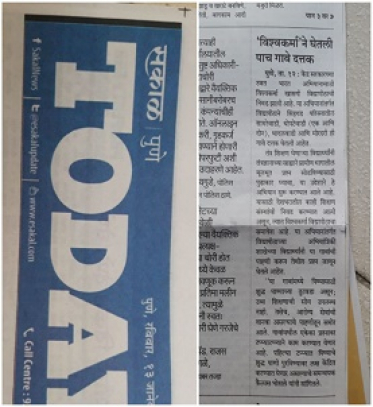
Sakal Today, Pune Edition dated 13th January, 2019
The activities of VU under this project will be monitored by coordinators of Unnat Bharat Abhiyan at IIT-Delhi and IIT-Bombay.

The rise of machines taking over the human world is no longer a dystopian dream. The dread that is associated with robots taking over the world is a reality from which there’s no escape. A great example is the manufacturing sector, which had long been a supplier of well-paying jobs and was is now transformed by the introduction of machines. But what about the white-collar jobs in the information technology sector? Will the emergence of machines have an impact on professions in journalism and media?
Automated journalism is shaking up the traditional journalism and the role of a news reporter by using computer algorithms to transform raw data into news stories that mimic the ones that a human may might have written. Media has long been at the forefront of technological innovation from satellite communications to the Internet and social media. With the advent of AI and big data, it was just a matter of time when journalism would be subject to the inevitable change in the way it’s produced and distributed.
Automated journalism takes the interaction of media with machines to a whole other level. It automates each step of the news production process, from investigation to the actual production and distribution of news. The automated news stories work well with fact-based stories where structured and reliable data can be transformed into content that is not just cheaper and quicker to produce but can also be personalized to the needs of the reader. No wonder it’s perceived as a threat to traditional journalism practices and quality and a precarity to the employment within the industry.
Automated Journalism Example
As publishers struggle to cope with dwindling newspaper subscriptions, Natural Language Generator models such as Automated Insights, Yseop, and Narrative Science have developed automated reporting systems, chatbots, and algorithms that have already been adopted by larger news organizations such as Associated Press, Forbes, The New York Times and Los Angeles Times.
The Washington Post has been experimenting news stories on the Heliograf smart software that made its debut in 2016 at the Rio 2016 Olympic games. By analyzing and reporting the data related to the games as they emerged, Heliograf was able to keep up with information relating to scores and medal counts in real time, freeing up journalists so they could work on creating other content. In its first year, the Heliograf produced as staggering 850 articles and was awarded the “Excellence in the Use of Bots” for its 2016 election coverage.
Using natural language technology, the tools spot patterns and trends in raw data, match them to the relevant phrases in the story template and add the information to create a narrative that can be published across different platforms. That too in seconds. Here’s an example of an automated news story by Associated Press.
Source: http://datadrivenjournalism.net/news_and_analysis/what_automated_journalism_looks_like_now_and_in_the_future
The typical uses of automated journalism include news stories on sports and finance – where it’s easier to crunch numbers and convert raw data into coherent news stories. As technology improves, robot journalism is likely to move into more challenging areas.
Machine Learning Journalism: Potential
The potential for machine learning journalism is endless. Speed and efficiency are two factors that distinguish AI article writers from their human counterparts. From monitoring technology, collecting statistics and writing and disseminating information, the potential of machine learning journalism is limitless, especially when it’s related to factual news such as weather forecasts, traffic reports, political results, and sporting events. Along with speed, one of the standout features of articles created by automated journalism is the reduction of errors and the need for human editing.
Robot Writing Limitations
Despite their multiple advantages, there are certain limitations that robot writing is plagued with. While the robot can place facts in a preset template, robots writing articles are severely lacking in the expression of emotions through the text like a journalist. The machine is unable to craft a colorful feature story or conduct an in-depth analysis of a subject. The lack of adaptability also means that robot journalists are unable to adapt to new styles of writing and new tools. Journalists fear that the widespread use of automation could lead to the loss of editorial identity in the long run.
One of the biggest disadvantages of automated journalism is the risk of fake news proliferation. Unlike a journalist, a machine is unable to detect certain flaws in a news story which can lead to the spread of fake news. For example, the Quakebot robot (specialized and designed to prevent earthquakes) accidentally announced an earthquake reporting several deaths when the earthquake was in fact 92 years old. While the cause of the mistake seems to be human, a human action caused the replacement of the date of the 1925 event by 2025, the robot failed to spot it and started disseminated the news.
Will Robots Replace Journalists
Instead of worrying about robots affecting job prospects, journalists can leverage automated journalism by using it as an assistant for focusing on data-driven stories and press releases while they focus on more complex topics that contain deeper analysis to increase their turnover and grow engagement for their brand.
According to Associated Insights, nearly twenty percent of a reporter’s time that is spent covering financial news can be freed up with the help of AI to improve accuracy and to give reporters more time to concentrate on the content and story-telling behind an article rather than the fact-checking and research. In the end, this could mean a win-win for journalism rather than its demise.
Sources
https://medium.com/@orge/this-is-the-future-of-journalism-will-a-machine-get-it-right-d3e747f16751;

Change is inevitable. We constantly need to adapt to changes surrounding us to be able to survive in the world and the manufacturing industry is no exception. Many companies have used artificial intelligence to improve their bottom line. Artificial intelligence helps identifying the flaws in the system, suggest purchases to new and returning customers and streamlines the supply chain process. In fact, according to the reports, supply chain is one area today that is leveraging the benefits of AI.
With the growth of manufacturing industries, the volume of data has also increased drastically. Hence, companies are looking for more sophisticated systems to make business intelligence processing more effective. This is the primary reason why manufacturing companies are ldepend on AI techniques to increase their productivity and increase revenue.
AI and Supply Chain Management
The prime responsibility of supply chain management is to respond to customer demands by providing exact supply match as efficiently as possible. There are three important factors that have led to an inability to match demand and supply: -
All these factors lead to failures and losses because our current systems are incapable of providing correct information in a timely manner to manage the demand and supply equation. Any kind of information gap is detrimental to an efficient supply chain. The big question is how does a company use artificial intelligence to better manage demand and supply.
Enhancing Demand Forecasting Accuracy
It is not easy to function in a supply chain environment if you are unable to forecast the demand. Traditional methods of forecasting included statistical techniques for forecasting. Historical sales data is used to predict demand. These techniques are unable to process large sums of data and have struggled from time to time in providing accurate information. However, with AI in place, it’s easier to provide precise data and improve demand forecast.
Bridging the Production Uncertainty Gaps
While working in the manufacturing industry, machines will break, and you will not always be able to deliver. This will further lead to low output, delayed shipments, and interruption in the supply chain. Artificial intelligence helps in maintaining equipment by continuously collecting information on equipment breakdowns. Timely repairs can be scheduled based on this information that help in avoiding delays.
Smarter Inventory Management
Managing inventory is one of the biggest challenges for every supply chain manager. However, with AI’s predictive modelling, it’s easier to predict how much stock is needed and decrease or increase production, thereby bringing down the cost of holding inventory.
AI is the Future in Supply Chain Management
Adopting the latest technologies to meet higher consumer expectations and demands is the need of the hour. AI helps throughout the supply chain management process with faster turnarounds for better results. Artificial intelligence will not only make people’s lives easier but also streamline businesses.